
News and Events
Next CURE seminar: Dr. Ingrid Gould Ellen, NYU – Friday, December 4, 2015
Friday, December 4, 2015
12:15pm – 1:30pm
Faculty Lounge, 3rd Floor Armitage Hall
Lunch will be served
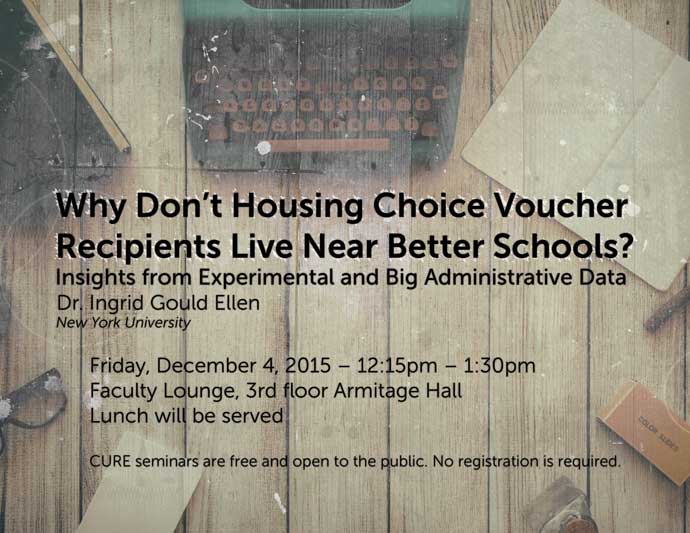
“Why Don’t Housing Choice Voucher Recipients Live Near Better Schools? Insights from Experimental and Big Administrative Data”
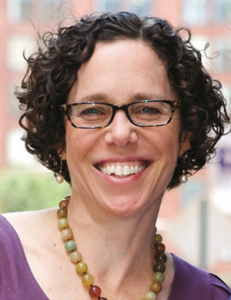
Dr. Ingrid Gould Ellen, NYU
 Housing choice vouchers provide low-income households with additional income to spend on rental housing in the private market. The assistance vouchers provide is substantial, offering the potential to dramatically expand the neighborhoods — and associated public schools — that low-income households can reach. However, existing research on the program suggests that housing choice voucher holders do not seem to spend the additional income provided by the voucher to reach better schools. We point out that many households have little incentive to move to areas with better schools because either they have no children or their children are older and the costs of disrupting their education to move them to a new school would be high. Using a combination of experimental and large scale administrative datasets, we show that the families for whom schools are most critical do appear to use vouchers to move towards higher-performing schools. Specifically, we find evidence that households whose oldest child meets the eligibility cut-off for kindergarten are more likely to move to higher-performing schools when they live in metropolitan areas that have softer rental housing markets (as proxied by higher vacancy rates), a greater share of affordable rental units located near high-performing schools, and neighborhoods with higher performing schools within a moderate distance.
~~~~~~~~~~~~~~~~~~~~~~~~~~~~~~~~~~~~~~~~~~~~~~~~~~~~~~~~
CURE seminars are free and open to the public. No registration is required.
Visitor Parking
Parking in Rutgers–Camden lots is by permit only. Visitors to Rutgers–Camden should obtain atemporary permit to park in a lot from 8 a.m. Mondays through 5 p.m. Fridays.? Contact Parking and Transportation for more information.?
Parking and Transportation
(within the Rutgers University Police Department)?
409 North Fourth Street?
856-225-6137
?Please visit these sites for directions to campus and to view a campus map
Symposium on Housing, Segregation, and Poverty
Tuesday, November 17th, 2015
Dr. Gloria Bonilla Santiago Building, Cooper and Broadway, 12th floor
Agenda
8:30am – 9am
- Registration and breakfast
- Opening Remarks:
Phoebe Haddon, Chancellor, Rutgers University-Camden
Paul Jargowsky, Director, Center for Urban Research and Education
9am – 10:30am
- Panel 1: Neighborhoods and Social Mobility
Chair: Paul Jargowsky
Discussants: Paul Jargowsky, Michael Hayes
Amy E. Schwartz, Keren M. Horn, Ingrid G. Ellen, & Sarah A. Cordes: “Do housing vouchers improve academic performance? Evidence from New York City”
Presenter: Sarah A. Cordes
Peter Rich: “White parental flight and avoidance: Neighborhood choices in the era of school district desegregation”
Stuart Andreason: “How housing regulation and segregation change the labor market benefits associated with increased educational attainment”
Edward G Goetz: “Choice and burden: Looking for fair housing’s greatest possible impact”
10:45am – 12:15pm
- Panel 2: Affordable Housing and Neighborhood Composition
Chair: Prentiss Dantzler
Discussants: Greg Squires, Prentiss Dantzler
Cody Price: “Why affordable home design matters”
Lei Ding, Jackelyn Hwang & Eileen Divringi: “Gentrification and residential mobility in Philadelphia”
Presenter: Jackelyn Hwang
Frederica D. Kramer: “Eating the seed corn: Loss of social diversity in urban revitalization and potential of social impact assessment to fix it”
Willow Lung-Amam, Katrin Anacker & Nick Finio: “Worlds away in suburbia: The changing geography of concentrated poverty in the Washington, DC metro”
Presenter: Willow Lung-Amam
12:15pm – 1:45pm
- Lunch Roundtable on Metropolitan Equity
David Troutt (Rutgers University, Newark)
Alex Schwartz (The New School)
Edward G. Goetz (University of Minnesota)
Moderator: Paul Jargowsky
2pm – 3:30pm
- Panel 3: New Directions in Housing Policy
Chair: Chris Wheeler
Discussants: Melanie Bowers, Chris Wheeler
Mai Thi Nguyen, Michael Webb, William Rohe & Kristin Frescoln: “Can housing vouchers and supportive services move families out of poverty? Lessons learned from a 5-year evaluation of HOPE VI in Charlotte, North Carolina”
Presenter: Mai Thi Nguyen
Jessica Simes: “Neighborhood attainment after prison”
Ingrid G Ellen, Keren M. Horn & Katherine M. O’Regan: “Using tax policy to reduce poverty concentration: Evidence from the low income housing tax credit”
Presenter: Keren M. Horn
Nicolas Vergara: “Ultra liberalized land market, social housing, and urban segregation. Lessons from the Chilean recent experience”
3:45pm – 4pm
- Concluding thoughts/emerging themes:
Paul Jargowsky - Introduction of Keynote Speaker:
Natasha Fletcher, Associate Director Center for Urban Research and Education
4:15pm – 5pm
- Keynote Address:
Professor Mark Stephens, MA, MSc, PhD, FAcSS, FRSA
Institute for Social Policy, Housing, Environment and Real Estate, School of the Built Environment, Heriot-Watt University, Edinburgh, Scotland, U.K.
5pm-6pm
- Reception
 This symposium would not have been possible without the generous support of: The Centers for Global Advancement and International Affairs (GAIA) and the Edward J. Bloustein School for Planning and Public Policy at Rutgers University-New Brunswick; The Center for Law in Metropolitan Equity (CLIME) and The Joseph C. Cornwall Center for Metropolitan Studies at Rutgers University-Newark; The Department of Sociology, Anthropology & Criminal Justice, the Office of the Dean of Arts & Sciences, and the Office of the Chancellor at Rutgers University-Camden; The Department of Community Development Studies and Education at the Federal Reserve Bank of Philadelphia.
Seminar about New Jersey Community Capital
Friday 11/20/2015
10:00AM-11:30AM
Faculty Lounge
3rd Floor, Armitage
311 N. 5th Street
Camden, NJ 08102
Seminar about New Jersey
Community Capital
Sponsored by the Walter Rand Institute for Public Affairs and
The Center for Urban Research and Education (CURE)
New Jersey Community Capital, a nonprofit community development financial institution fostering the creation of quality homes, educational facilities, and employment opportunities in underserved communities of New Jersey, has been contracted by the Pascale Sykes Foundation to leverage $4 million into $15 million to do economic development in Atlantic, Cumberland, Gloucester, and Salem Counties. The project is called THRIVE South Jersey.
Join Marie Mascherin and Diane Sterner of New Jersey Community Capital as they describe their work in Camden and the opportunities that their initiative can provide to Rutgers students, faculty, and staff.
Ph.D. Student Explains American Community Survey Data Showing Camden’s Drop in Poverty
In mid-September, the U.S. Census Bureau released the most recent data from its American Community Survey, an ongoing study that provides vital demographic information, such as jobs, occupations, house ownership, and educational attainment.
 At the time, Chris Wheeler, a Ph.D. candidate in public affairs-community development at Rutgers University–Camden, read how analysts cited in local media reports were baffled by statistics showing a sudden drop in poverty in Camden. So he did a little digging.
“When I looked further into some of the demographic and economic indicators, the reasons for this drop became quite clear,” says Wheeler, a Willow Grove, Pa., resident, who grew up in nearby Glenside.