 Please join us for our next seminar:
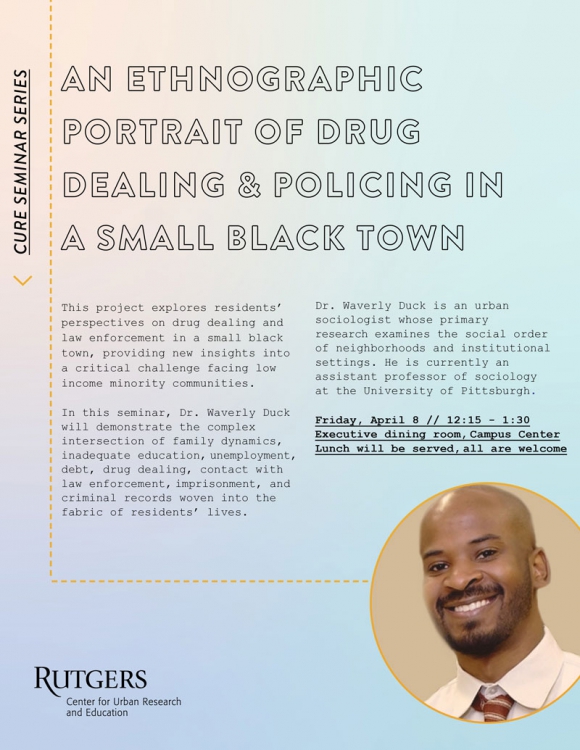
“An Ethnographic Portrait of Drug Dealing and Policing in a Small Black Town”
 Waverly Duck, Ph.D.
Assistant Professor of Sociology
University of Pittsburgh
Friday, April 8, 2016
12:15pm – 1:30pm
Executive Dining Room, Campus Center
Lunch will be served
This project explores residents’ perspectives on drug dealing and law enforcement in a small black town, providing new insights into a critical challenge facing low-income minority communities. In-depth ethnographic studies provide a unique opportunity to capture the cultural narrative of deprivation that exists in poor African American neighborhoods today. Few legitimate economic opportunities are available to these residents, and those that do exist come with risks. For example, with no legal jobs nearby, residents must commute long distances by car to get to work. Dr. Duck examines the accounts of several residents with regard to law enforcement and drug dealing over a seven-year period, and shows how they are embedded in a local interaction order—a set of patterned relations governed by endogenous rules and conventions whereby residents organize and coordinate their social lives. In doing so, he demonstrates the complex intersection of family dynamics, inadequate education, unemployment, debt, drug dealing, contact with law enforcement, imprisonment, and criminal records woven into the fabric of residents’ lives.
Waverly Duck is an urban sociologist whose primary research examines the social order of neighborhoods and institutional settings. His academic areas of interest are urban sociology, inequality (race, class, gender, health and age), qualitative methods, culture, ethnomethodology and ethnography. His research on masculinity, health, crime and violence, and inequality has appeared in the journals Ethnography, Journal of Urban Affairs, Sociological Focus, Critical Sociology, Annals of the American Academy of Political and Social Science, Crime, Law and Social Change and African American Studies. His book, No Way Out: Precarious Living in the Shadow of Poverty and Drug Dealing with the University of Chicago Press, challenges the common misconception of urban ghettos as chaotic places where drug dealing, street crime, and random violence make daily life dangerous for everyone. No Way Out explores how neighborhood residents make sense of their lives within severe constraints as they choose among very unrewarding prospects. His second manuscript, Ethnographies is under contract with Roudtledge Press, examines the history of ethnography in sociological research.
~~~~~~~~~~~~~~~~~~~~~~~~~~~~~~~~~~~~~~~~~~~~~~~~~~~~~~
CURE seminars are free and open to the public. No registration is required.
Visitor Parking
Parking in Rutgers–Camden lots is by permit only. Visitors to Rutgers–Camden should obtain a temporary permit to park in a lot from 8 a.m. Mondays through 5 p.m. Fridays.? Contact Parking and Transportation for more information.?
Parking and Transportation
(within the Rutgers University Police Department)?
409 North Fourth Street?
856-225-6137
?Please visit these sites for directions to campus and to view a campus map

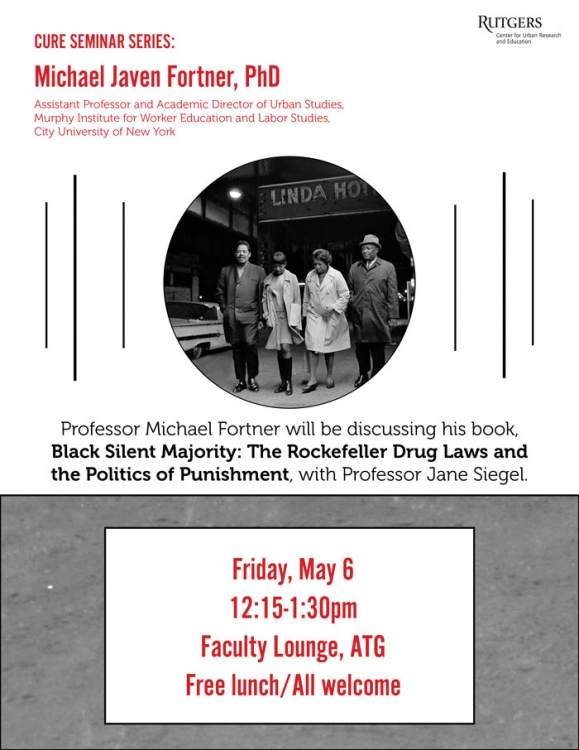 Please join us for our next seminar:
 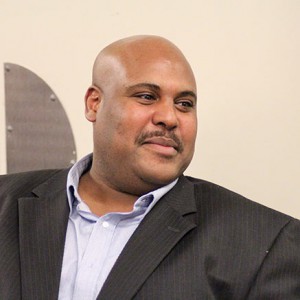 Michael Javen Fortner, PhD